Studio Release Fall 2026
Slow Happenings: Paintings & Drawings
Over the past year, I’ve been exploring how time unfolds at varying scales. If we consider objects, trees, or people on longer time scales, would we find that we are all long events, slow happenings? This series of paintings explores that idea through still lifes, tree portraits, and seascapes. What does it look like for a tree to slowly become its next self? How does a notebook or a cup of coffee reflect and shape and record the life lived around it?
Paintings emerge in conversation with the world. For each set of paintings and drawings, I have included what I feel are key references that, in some way or other, helped me find my way to them.
“We can think of the world as made up of things. Of substances. Of entities. Of something that is. Or we can think of it as made up of events. Of happenings. Of processes. Of something that occurs.”
– The Order of Time, by Carlo Rovelli
This set of paintings is an ongoing exploration of the objects that move with me throughout the days, that record or shape or reflect daily living. As a child I collected little trinkets, taking them out now and again, admiring the familiar colors and textures. As an adult, my collections are stacks of books and notebooks, ceramic water glasses and engraved spoons that one day appeared in the drawer.
I thought about this series for a long time before I finally put brush to paper, trying to figure out the right way to approach this underlying idea. Ultimately, I landed on the idea of working from what I call “found compositions,” capturing objects as they have been arranged through use. I don’t do any re-arranging of the objects, instead keeping an eye out as I proceed through my day for a scene that strikes me. Most often I find these compositions in the morning, either reflecting the work of the previous evening or a slow start to the day.
References
Painting on paper (and much else) inspired by the work of Nicolás Uribe.
Sofia Samatar in Opacities, describing writer Bruno Schulz’s process: “his stories came to life when ordinary objects around him began to ‘wink’ or ‘radiate.’”
“We are the diagram of the functions of inhabiting that particular house.” – The Poetics of Space, by Gaston Bachelard
Conversation with a coworker many years ago about how we can feel the presence of others in our home by the way objects are somewhere one day and elsewhere the next.
Treatment of color and form in Ed Praybe’s still life paintings.
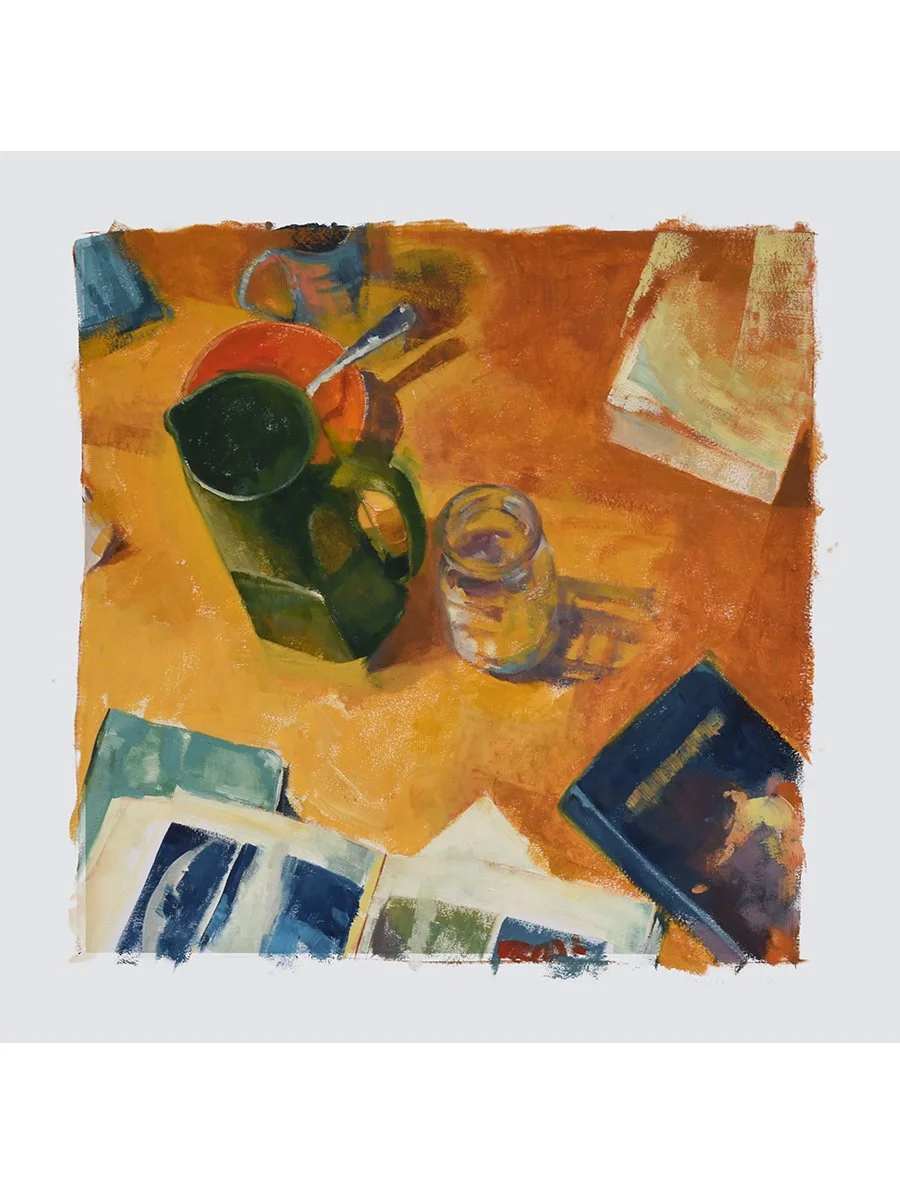
14×14” / Oil on unprimed paper / Framed under glass
Please note this piece will be available for pick-up at the beginning of November 2026
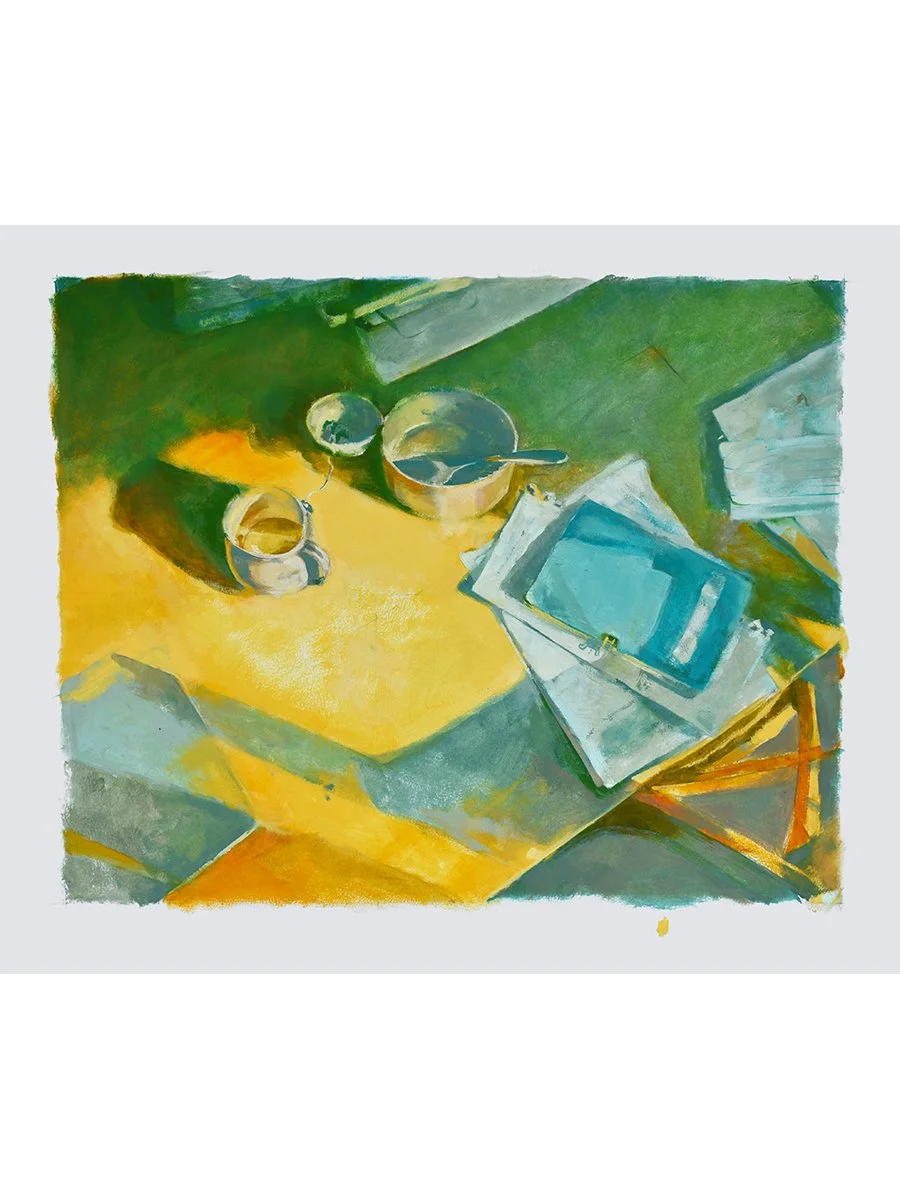
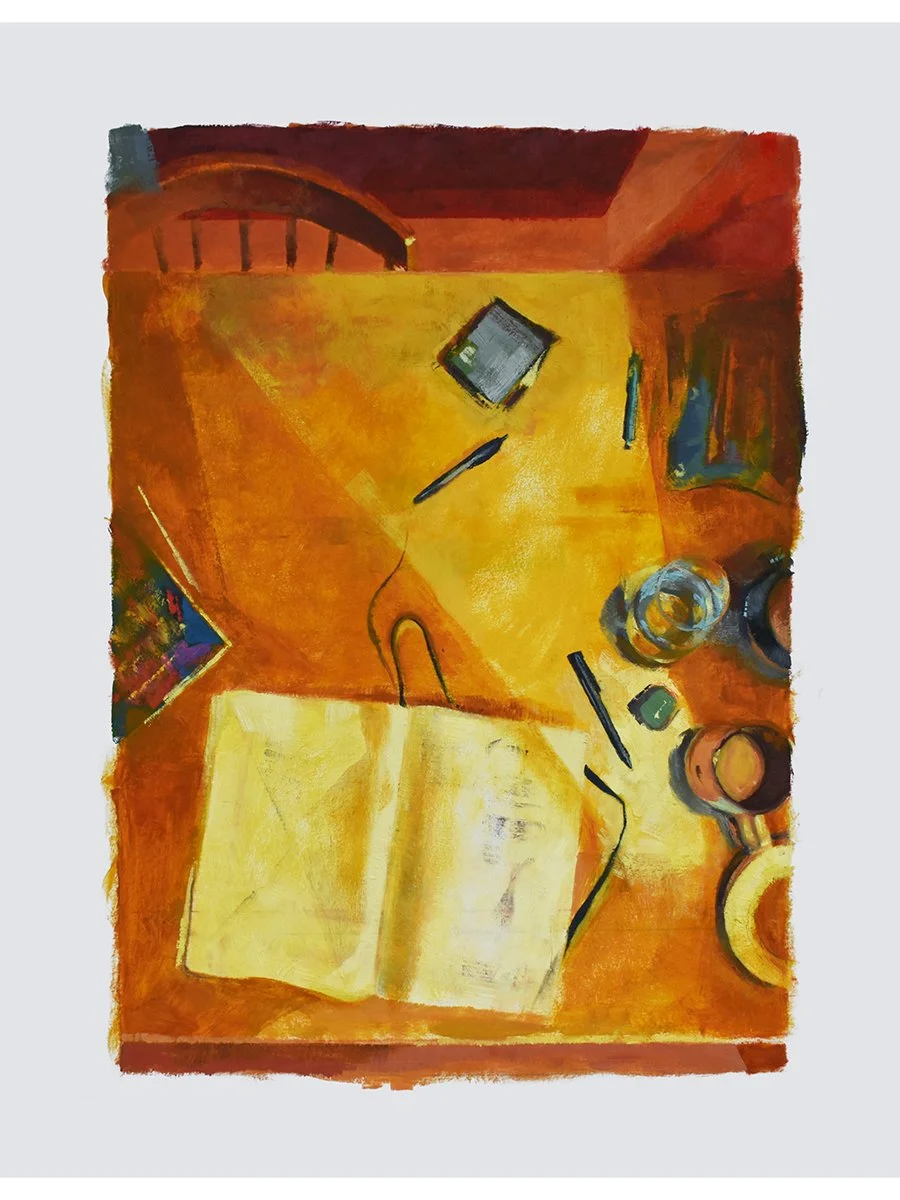
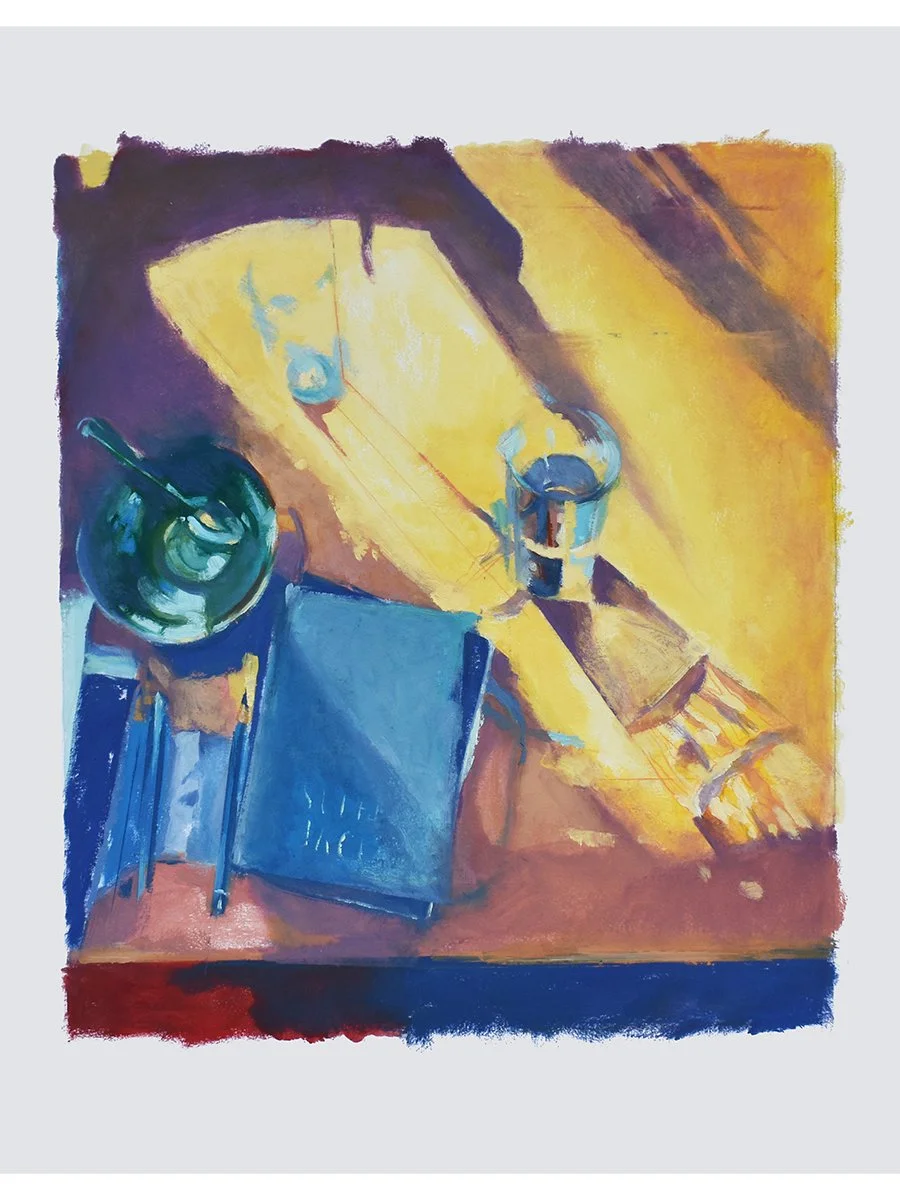
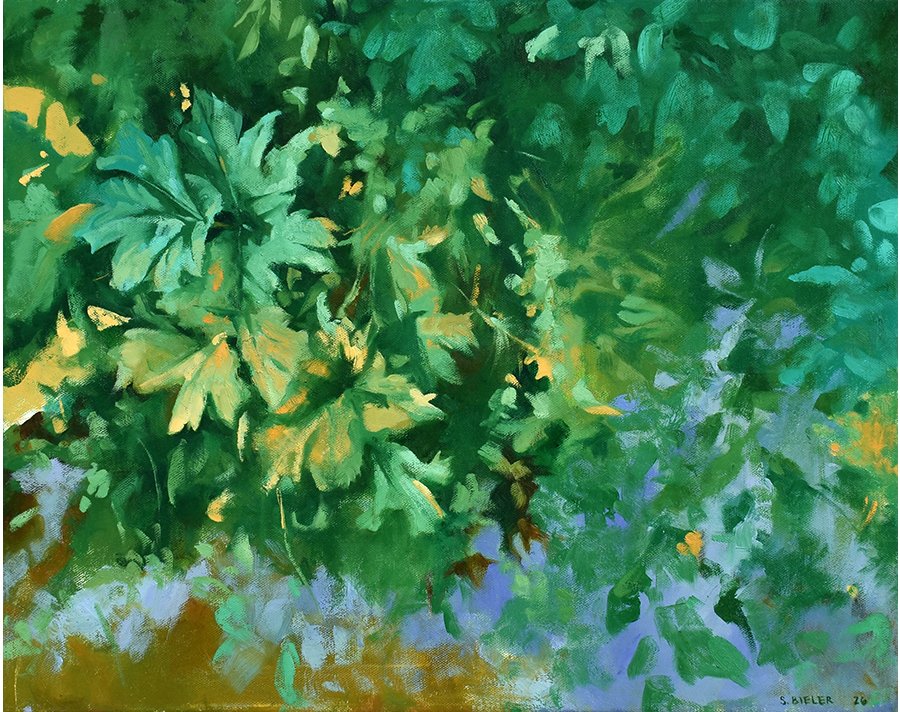
16x20” / Oil on canvas / Pine float frame
Please note this piece will be available for pick-up at the beginning of November 2026
I often find my eyes wandering to the ground or the sky for inspiration — I’ve never been much of a “look straight ahead” walker. This scene is from the bog near my house; I was struck by the mixed texture of the leaves and the range of yellow- to blue- greens.
For many years I’ve been fascinated by the idea of “boundary layers” — the small layer of air that hugs surfaces, like leaves. This space functions as its own microclimate. Where does one thing end and another begin? On smaller and smaller scales, the delineation seems to blur.
From a technical standpoint, this painting was an experiment in using cool and warm colors to create visual harmony out of a scene of dense foliage. Except for the gray areas, this painting is made with only two colors: Phthalo Green and Transparent Orange.
References
Edgeless plant paintings by David Dibble.
Gathering Moss, by Robin Wall Kimmerer, where I first learned that all surfaces have a boundary layer.
Stewart Brand in How Buildings Learn, on the “continuous very small feedback loop adaptation” that allows incredible structures in nature to emerge. I wonder at how this mess of leaves and stems grew around itself.
Painting neighborhood trees and painting still lifes often feels like the same thing to me – they’re both about observing the specific pace at which familiar, seemingly constant spaces shift and unfold.
This set of paintings explores the trees I see nearly everyday. I love painting trees because I am fascinated by their experience of place. Every day, I move through space, observing bits and pieces of time in any one location. When I come back – an hour, a day, or a week later, surely much has changed, most of which I can only guess at or imagine or deduce. Trees, on the other hand, witness everything that happens in the one spot where they are rooted. Space, time, motion, stillness.
References
The incredible negative spaces between the trees at the bog.
Zoey Frank’s experimental approach to color.
Annie Dillard’s endless search for “the tree with the lights in it” – where the sky and the canopy merged – that one day finally found her, as told in Pilgrim at Tinker Creek.
Brian Greene’s descriptions in The Elegant Universe of the different experience of time between a moving body and its stationary counterpart: “If an object is sitting still (relative to us) and consequently does not move through space at all, then…all of the object’s motion is used to travel through [time]…If an object does move through space, however, this means that some of the previous motion through time must be diverted.”
In The Poetics of Space, Gaston Bachelard’s description of how the “far-off” house “sees, keeps vigil, vigilantly waits.” This description so clearly evoked trees in my mind.
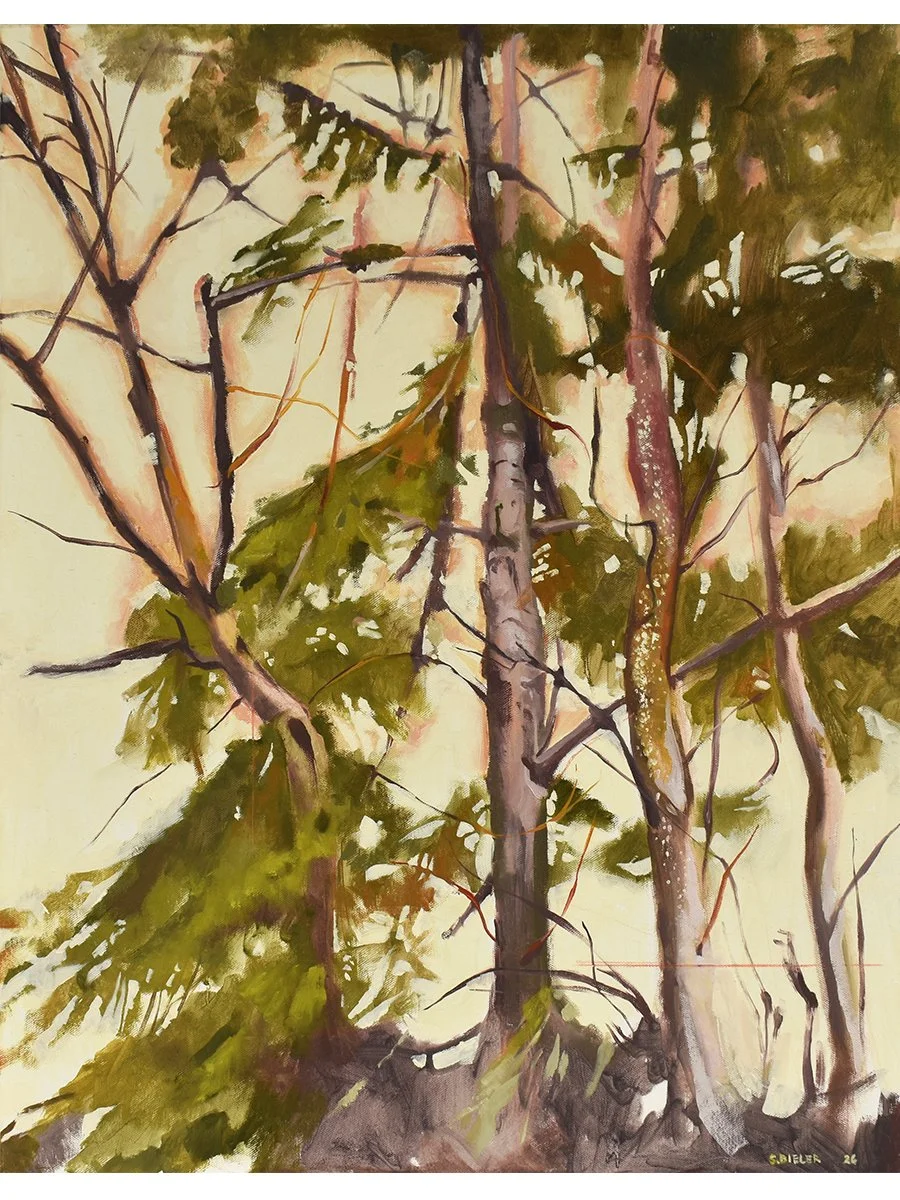
22×28” / Oil on canvas / Pine float frame
Please note this piece will be available for pick-up at the beginning of November 2026
This painting is an experiment in isolating a subject from its background, in taking a landscape painting and treating it more like a portrait or still life, where a subject is placed against a simple background. Four trees are aligned in a row, blending and overlapping on one picture plane that creates a strange sense of space for a forest scene. I was fascinated by how this flattening of space brought out beautiful patterns and visual rhythms that would otherwise be more obscured.
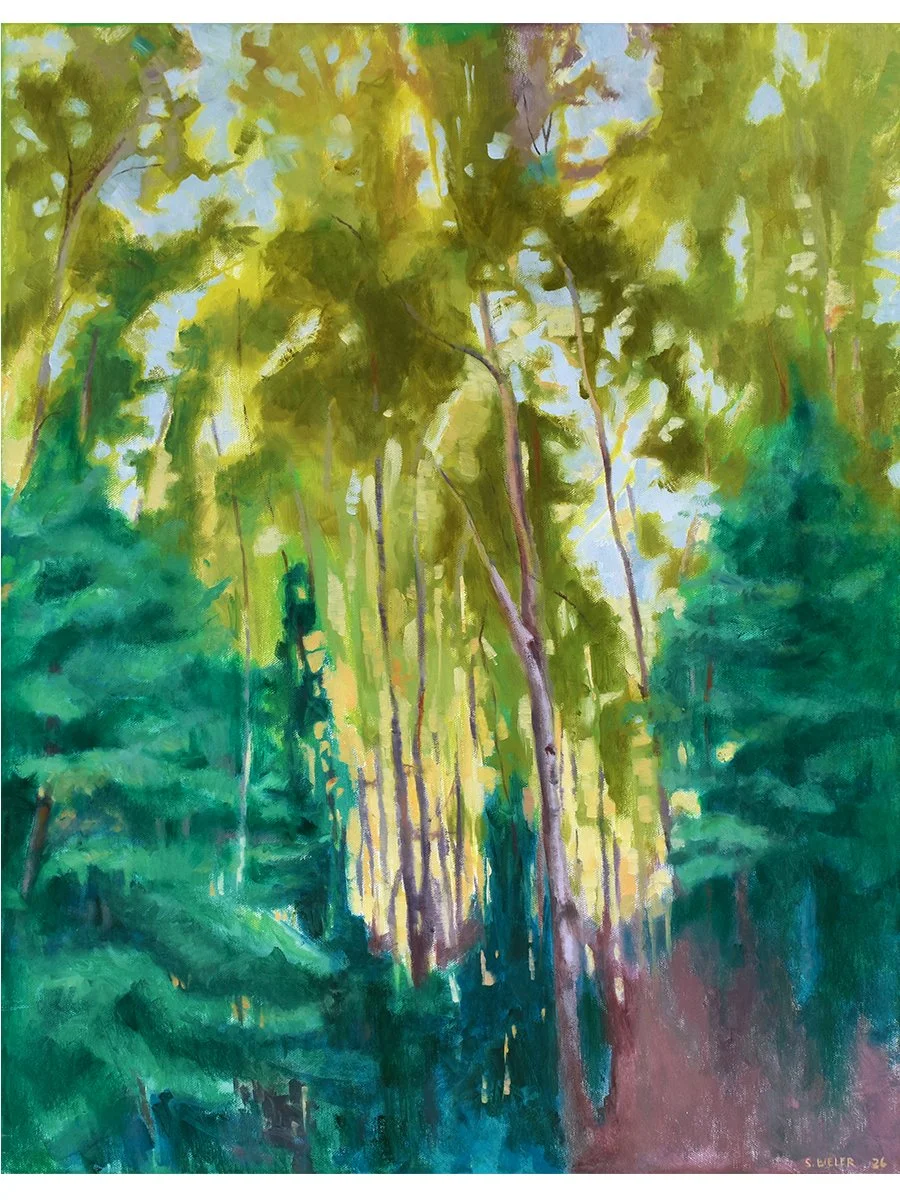
22x28” / Oil on canvas / Pine float frame
I loved the shapes of the canopy in this picture, the physicality of the negative space. My goal with this painting was to bring the background and subject together, a nod to Annie Dillard.
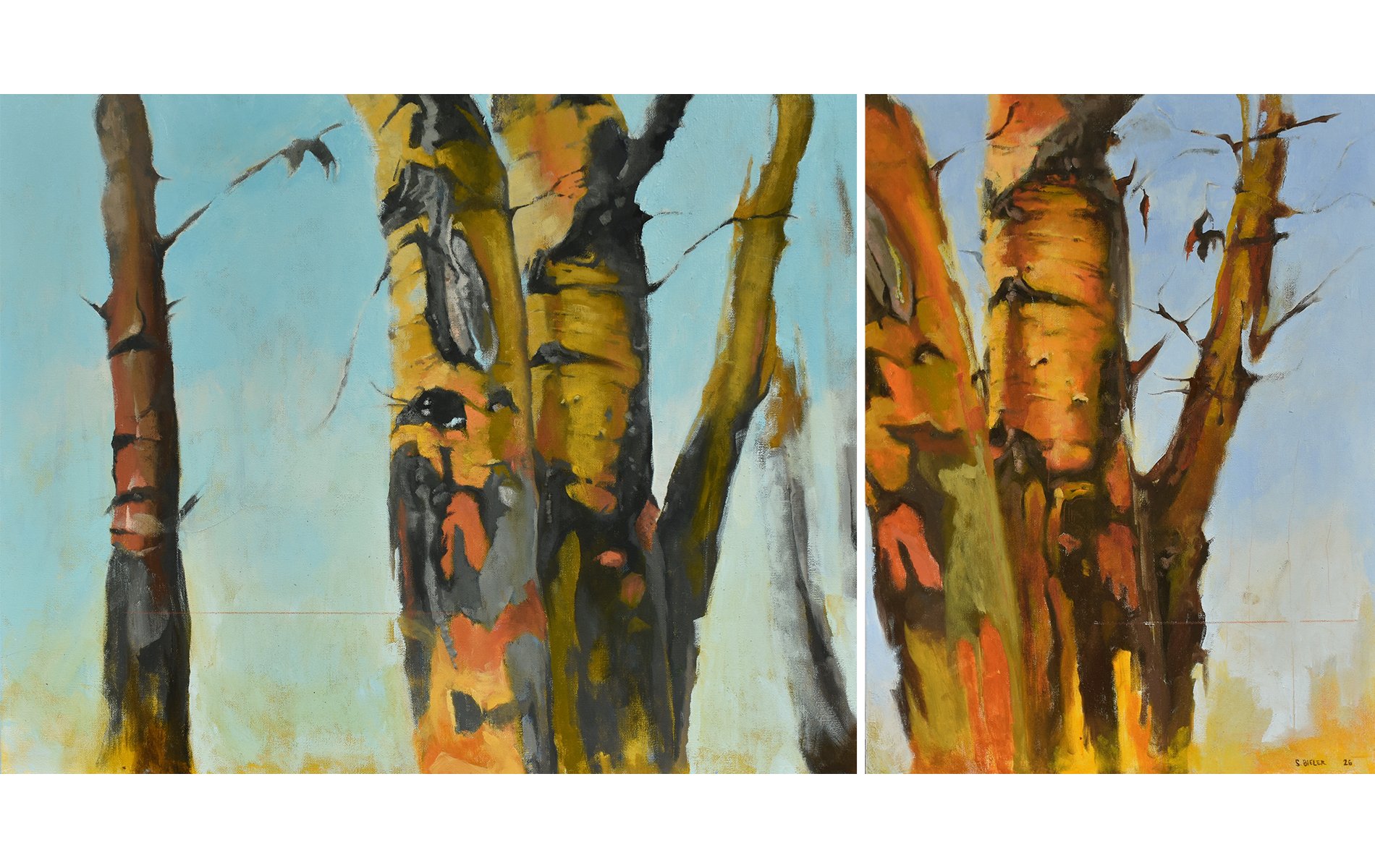
48x24” / Oil on canvas / Two unframed panels
This diptych shows the same scene from two slightly different perspectives, observed as I walked past this set of trees.
I was interested in using this painting to explore how two images of the same subject can be differentiated. In this case, each panel reveals something slightly more about the picture – a detail not found in the other, a change in the viewing angle, a shift in color. Each is a picture in itself; together, they make a more complete picture. And still there are an infinity of angles to observe from.
The panels are intended to be hung side by side with a .5” inch gap.
These pieces are created in two steps – first, making the drawing; then, cutting it into (random) pieces and re-assembling them into a new form. To find the new composition, I search for interesting alignments between shapes, values, and textures. These drawings are all about the process for me: the challenge of cutting up a “finished” drawing, and the belief that I’ll find something worthwhile in the pieces. Sometimes, the new composition is obvious, and sometimes I go through many iterations.
I first found my way to this method of working in school, when I built a large curve of laminated wood for a sculpture class. The day before the assignment was due, I remember the course teaching assistant coming over to my work station and asking me what the piece was trying to say. I said I wasn’t sure, that I was just enjoying building a curve, that I could find depth in my writing but it was hard for me to find in visual art. And he said yes, it can be hard, but what can I make of it before tomorrow? That night, I decided to cut the curve into pieces and arrange them into a new structure, pieces counterbalanced against each other. The piece became about process, about the experience of taking apart something I had spent many hours putting together, and seeing what I could trust it to become next.
Since then, I’ve tried to consistently incorporate this practice into my work.
References
The teaching assistant who encouraged me to try to find the depth.
Multi-piece drawings that break the rectangle by Zoey Frank.
Sofia Samatar in Opacities, on metaphor, the science of how surfaces interact, and “the persistence of enchantment.”
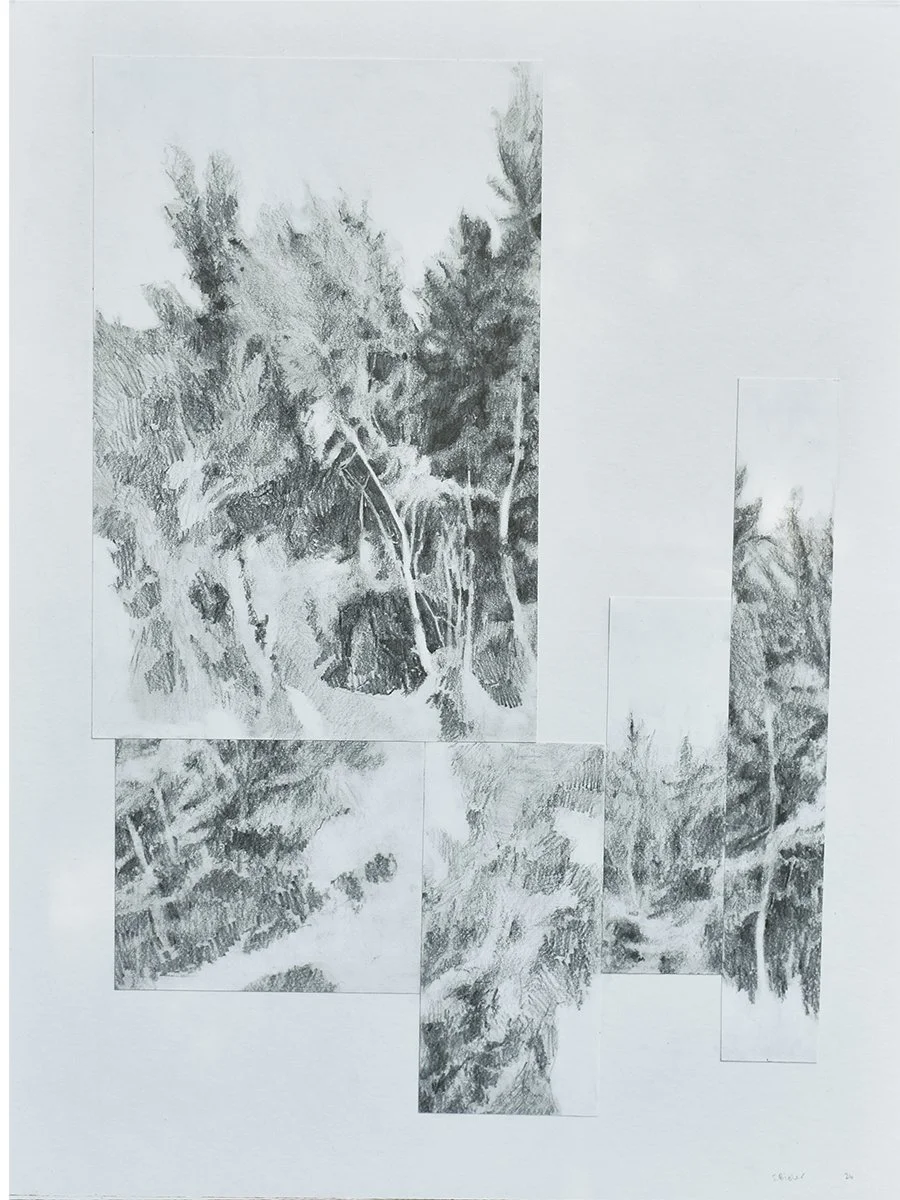
18x24” / Collaged pencil on paper / Wood frame with glass
Please note this piece will be available for pick-up at the beginning of November 2026
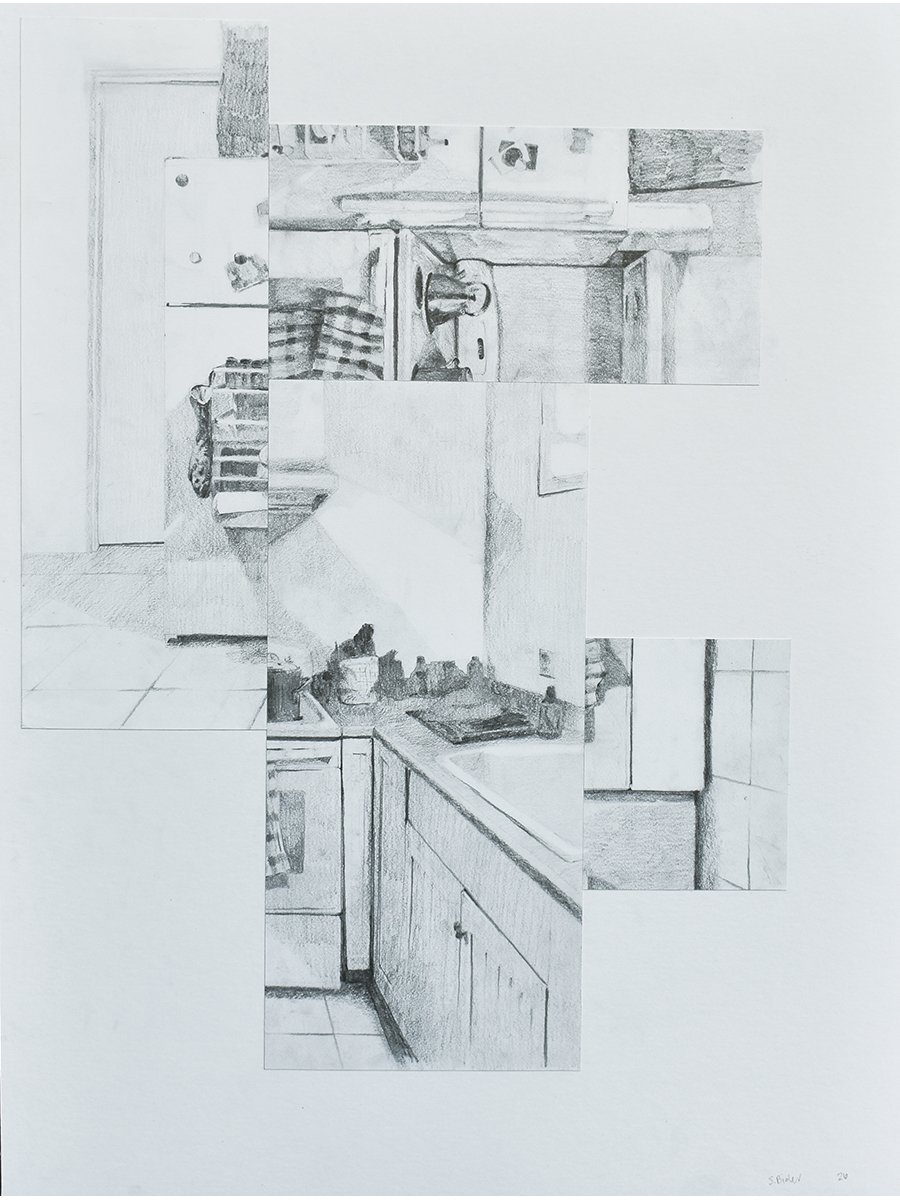
18x24” / Collaged pencil on paper / Wood frame with glass
Please note this piece will be available for pick-up at the beginning of November 2026
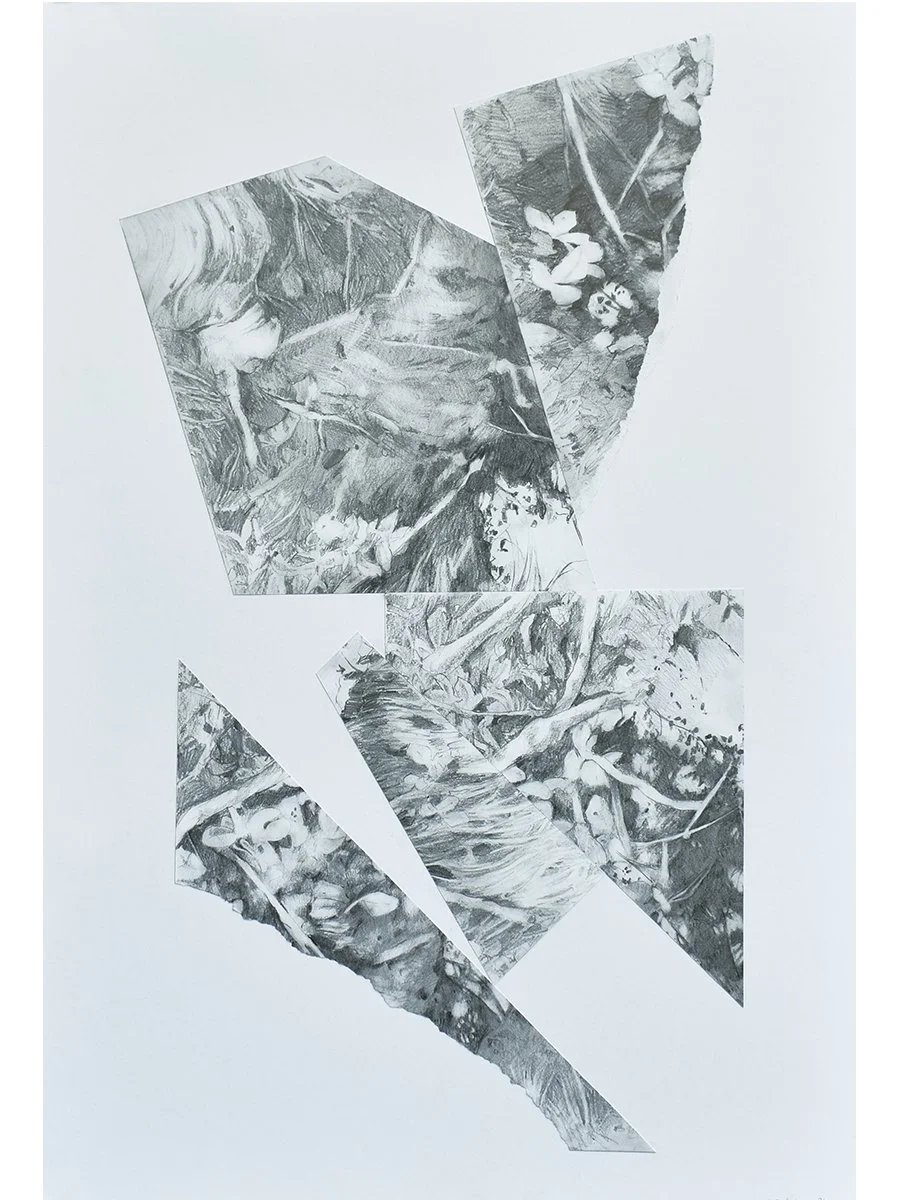
19.5x29.5” / Collaged pencil on paper / Wood frame with glass
Please note this piece will be available for pick-up at the beginning of November 2026
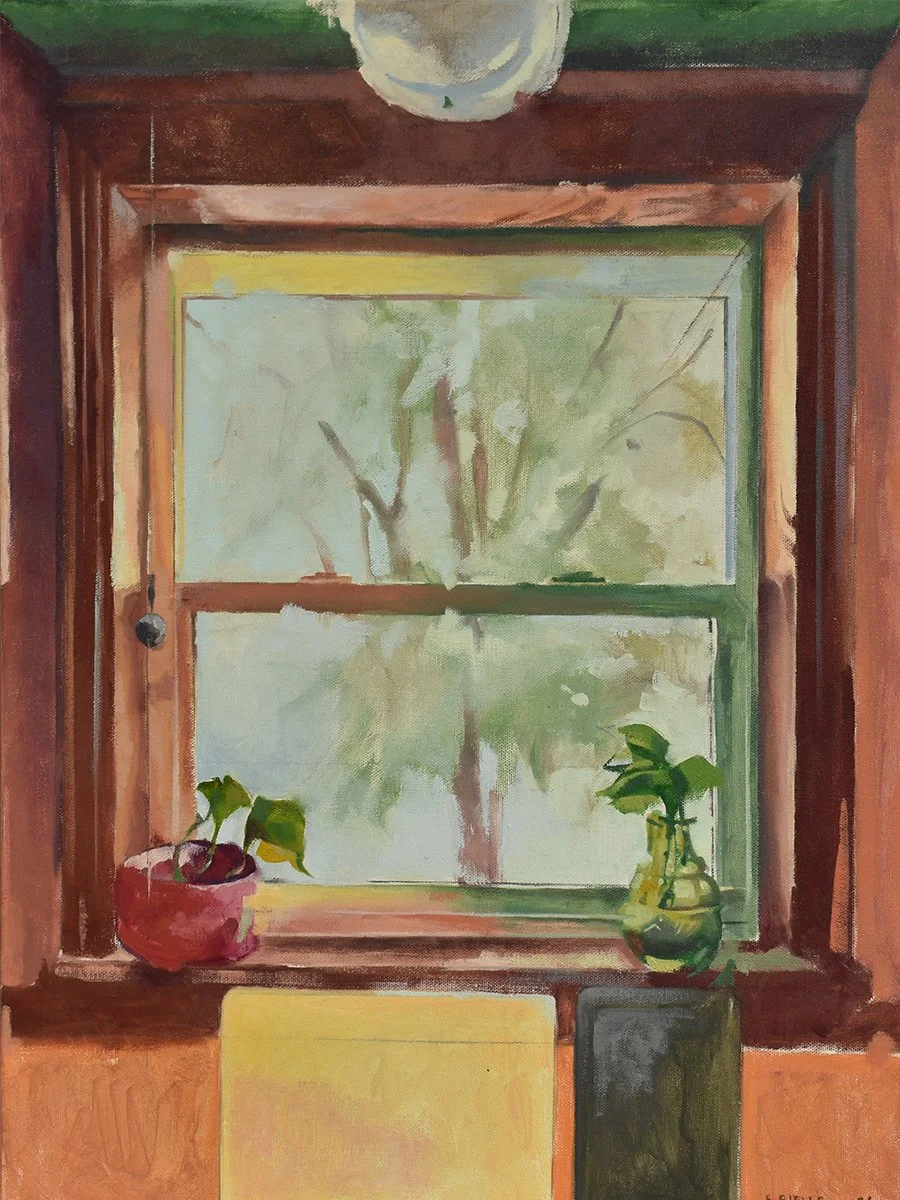
18x24” / Oil on canvas / Unframed
Please note this piece will be available for pick-up at the beginning of November 2026
This is a painting of my kitchen window looking out onto the 13 trees in our yard. I love painting windows; they create these familiar frames around the world, the same view day after day. And in this repetition, they allow us to notice little shifts and changes. Windows are a site where inside and outside merge.
I’ve also always had a fondness for nooks and crannies. There’s often something a little magical or mysterious about corners of rooms, about the meeting of edges and surfaces. These are areas of real visual interest — different geometries meeting and in doing so creating unexpected turns of color, plays of light and shadow. In this scene from early Anchorage spring, I loved the interaction of luminous and dark spaces.
References
“If one were to give an account of all the doors one has closed and opened, of all the doors one would like to re-open, one would have to tell the story of one’s entire life.” – The Poetics of Space, by Gaston Bachelard
“All corners are haunted, if not inhabited…As for me, I let myself be caught [in the corner]. I followed the molding.” – The Poetics of Space, by Gaston Bachelard
Window paintings by Edward Hopper, which have come back and back to me over the years.
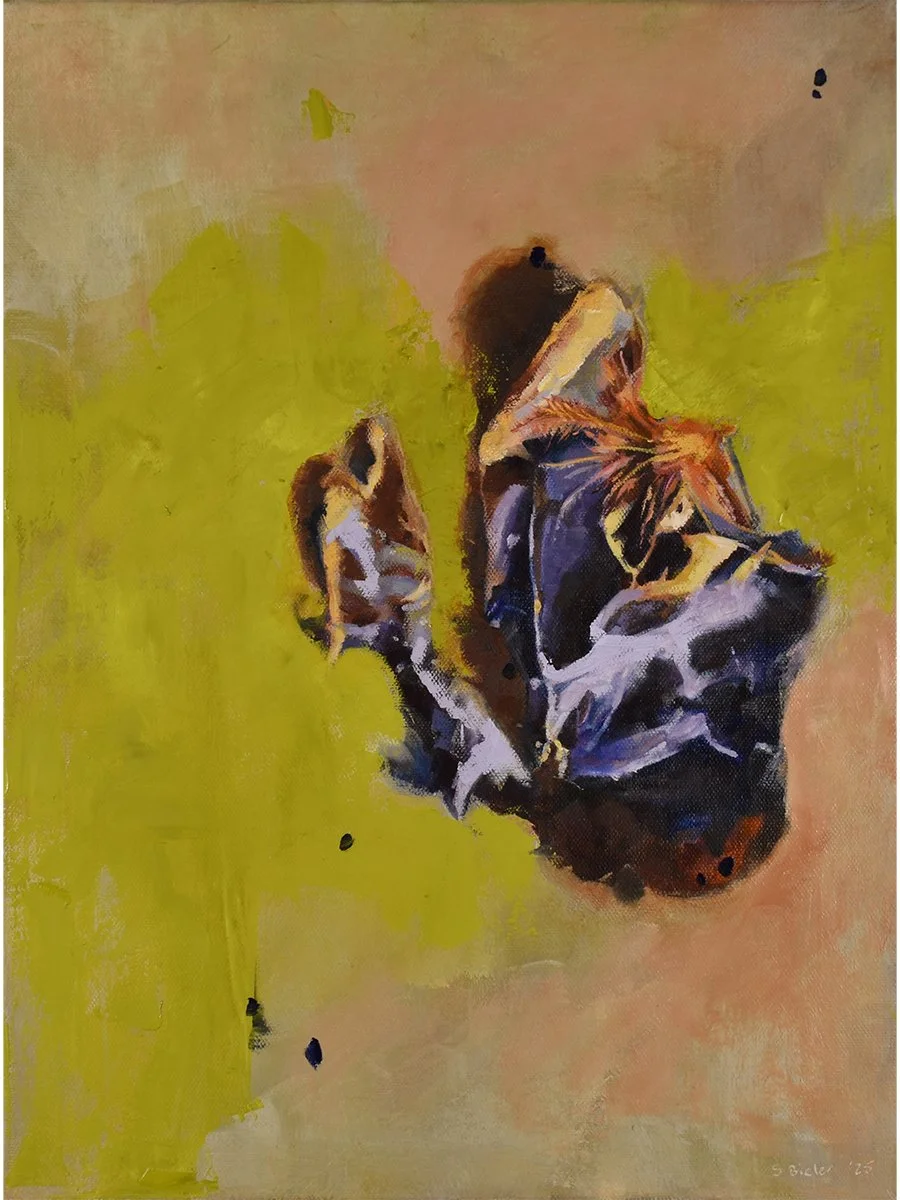
12x16” / Oil on canvas / Pine float frame
Please note this piece will be available for pick-up at the beginning of November 2026
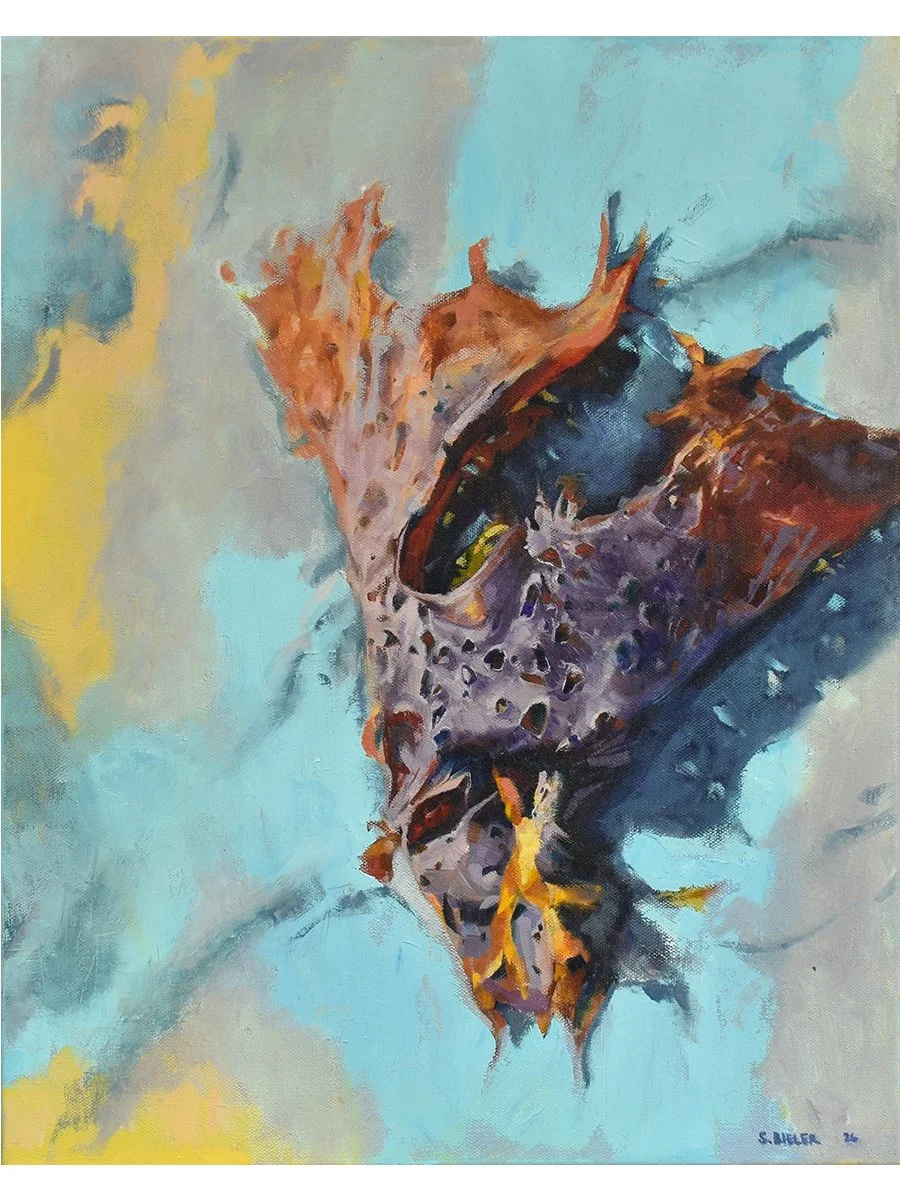
16x20” / Oil on canvas / Pine float frame
Please note this piece will be available for pick-up at the beginning of November 2026
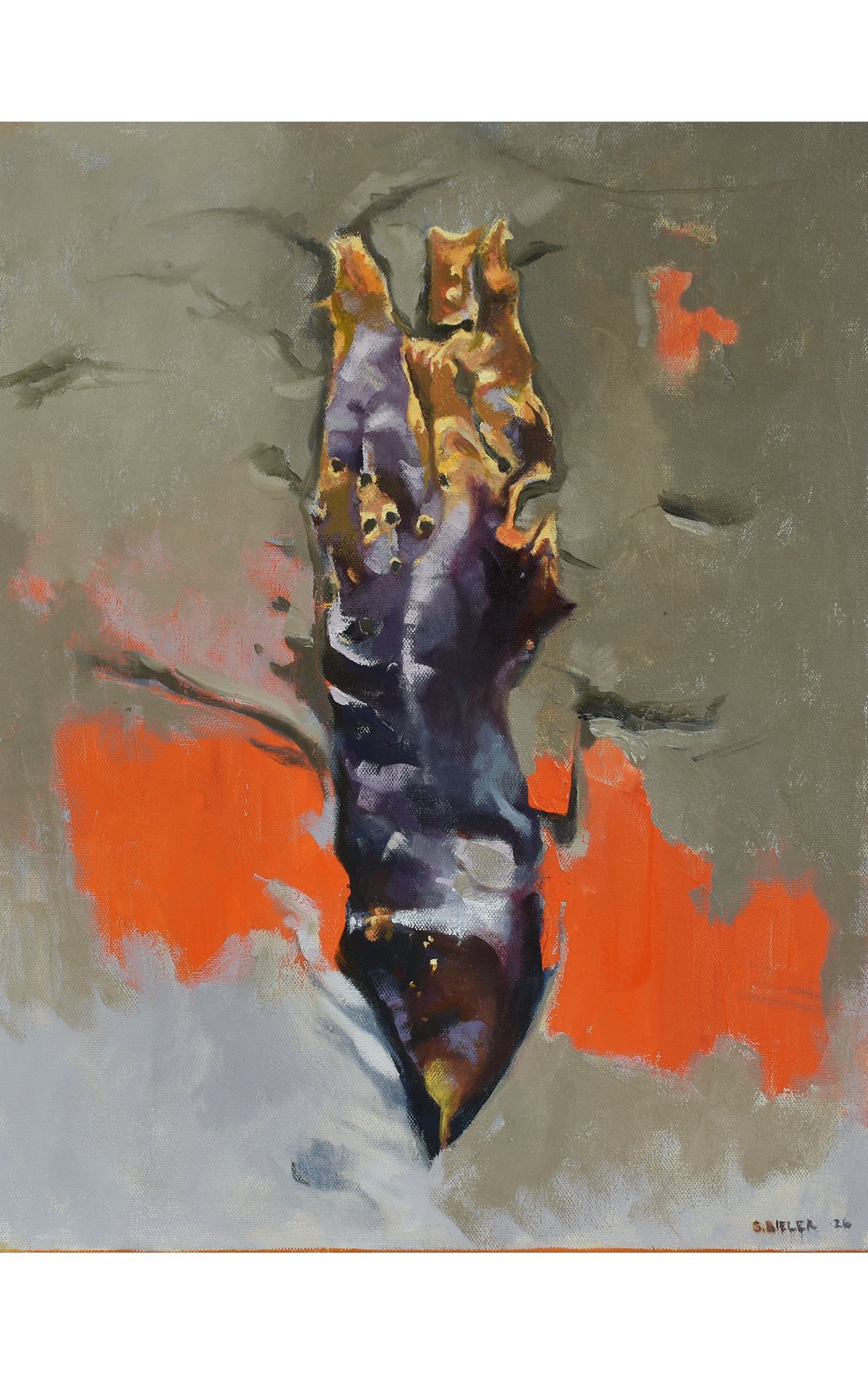
16x20” / Oil on canvas / Pine float frame
Please note this piece will be available for pick-up at the beginning of November 2026
Recently, I can’t stop painting seaweed. I’m fascinated by its form – opaque in some places, transparent in others; changing color everywhere I look; alternately shiny, dull, speckled, smooth...and all the while draping across the sand like fabric. I think it must be one of the most exciting subjects to paint because of the sheer amount of visual information in every inch.
I love the traces seaweed leaves, too – the incredible whirling patterns where form and sand and water meet. And the edges where the seaweed turns to sand, comes back again, and disappears. It’s there and then gone.
References
Two words from linguistics: Synchronic: existing or happening at a particular point in time. / Diachronic: looking at context, studying how something changes and develops over a period of time
Soetsu Yanagi’s reflections in The Beauty of Everyday Things on how, once a flower has lost its petals, it cannot be put back together into the living thing. It reminded me of fallen leaves, and of seaweed washed onto the beach. He says, “the kinematic can be transformed into the static, but not the reverse.”
Stewart Brand quoting Brian Eno in How Buildings Learn, on the sense of meaning we find in evidence of growth, evolution, complexity, depth. He says we are drawn to those things which “not only show that they have been through a process of evolution, but which also show they are still part of one.” I have found no visit to the beach to ever be the same.
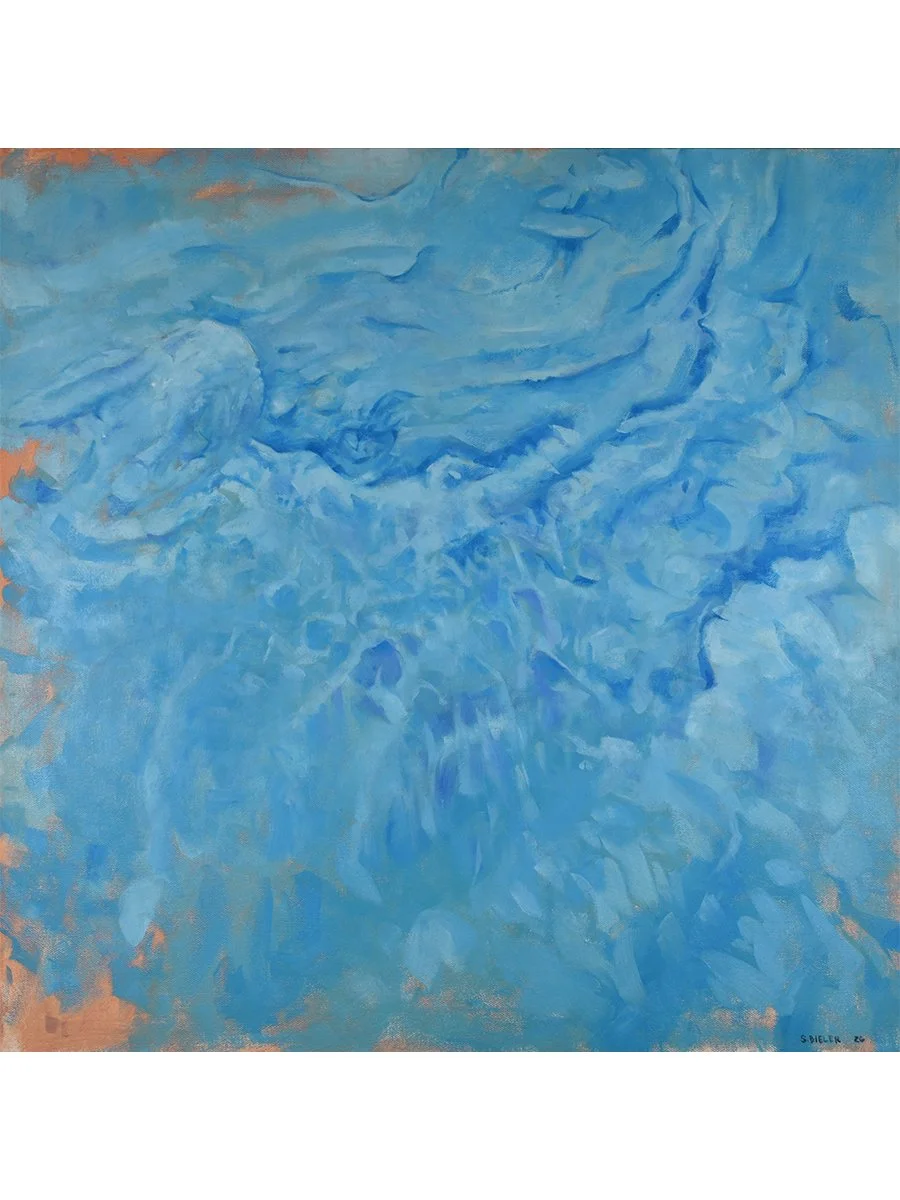
24×24” / Oil on canvas / Pine float frame
Please note this piece will be available for pick-up at the beginning of November 2026
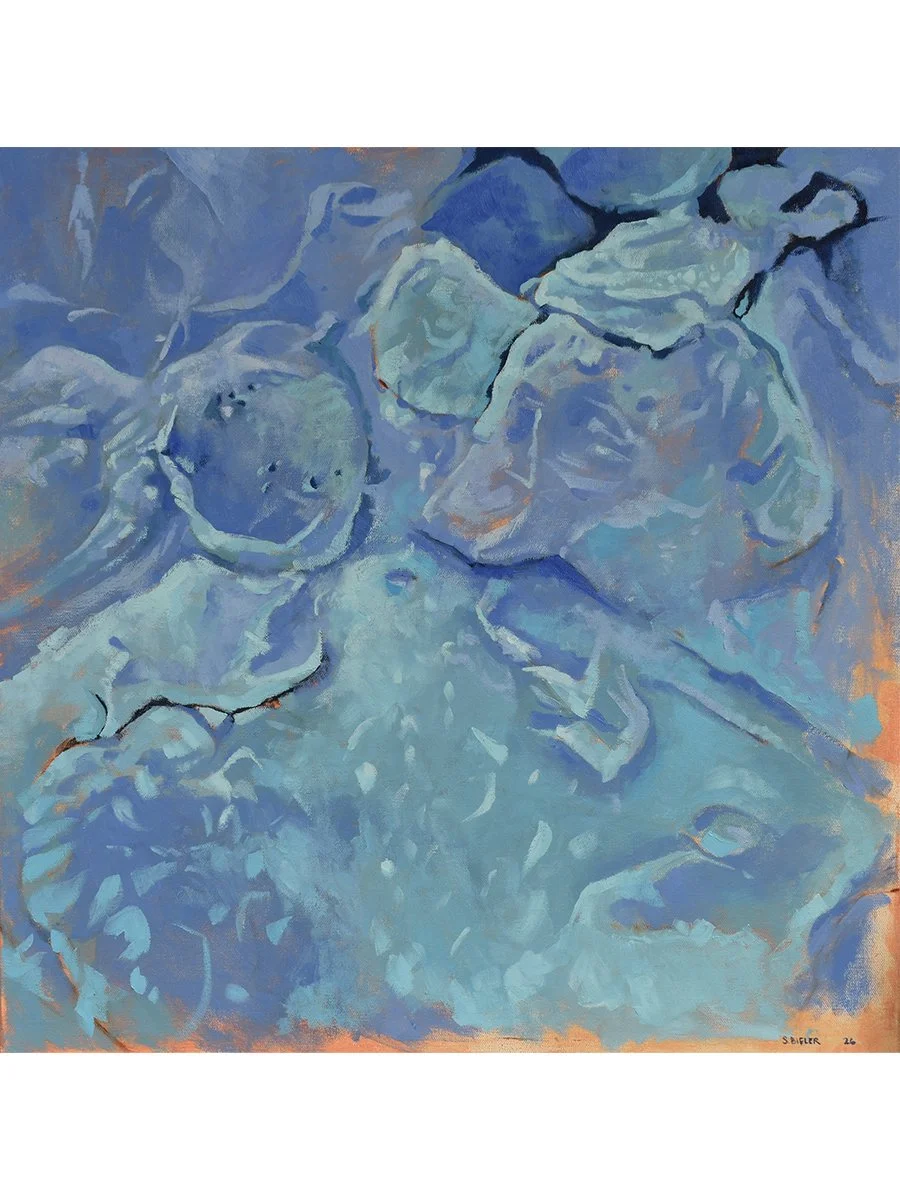
24×24” / Oil on canvas / Unframed
Please note this piece will be available for pick-up at the beginning of November 2026
Many of my paintings are about the edgy places where different surfaces meet – transition spaces where the world is many things all at once.
Frozen ground studies are one of my favorite ways to explore this. I love the subtle shifts in color and texture, and the patterns that emerge as water freezes and thaws, simultaneously making its own forms and taking the forms of what it passes over. I am especially interested in playing with how shifts in scale, perspective, and states of matter change how we understand these sites of interaction between water and land. These landscapes have always reminded me of the sky, of galaxies and planets.
References
Images of space in Carl Sagan’s illustrated Cosmos.
A February 2019 lecture, “The Invention of Rivers,” by landscape architect Dilip da Cunha: “Why do we see water as ‘somewhere’ when it is held everywhere?” I think about this walking on frozen ground, splashing through ponds, dragging through mud...
Neil Theise in Notes on Complexity, on how the things of the world appear to us as they are because of the specific scale we live at: “everything only looks like a thing, from its own particular vantage point, the level of scale at which it can be seen as ‘itself,’ as a whole.”
I read this in conjunction with Carlo Rovelli in The Order of Time, reminding us that surfaces are not in fact solid: “Everything in the world becomes blurred when seen up close. Where exactly does the mountain end and the plains begin? “